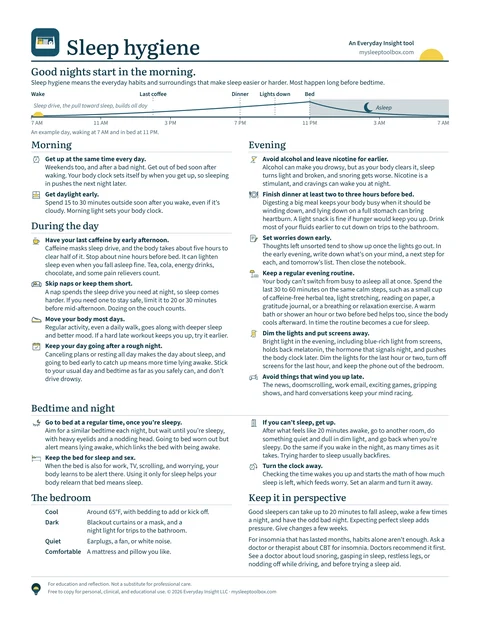
Sleep hygiene handout
The everyday habits and surroundings that make sleep easier or harder, on one page, from morning light to the bedroom at night. Free to print, copy, and share with clients, groups, or anyone sleeping poorly.
Download the sleep hygiene handout PDF Spanish sleep hygiene handout PDF
What’s on it
Sixteen everyday habits, in the order the day happens, from morning light to the bedroom at night. A timeline across the top shows sleep drive building from waking to bed.
Morning
- Get up at the same time every day.
- Get daylight early.
During the day
- Have your last caffeine by early afternoon.
- Skip naps or keep them short.
- Move your body most days.
- Keep your day going after a rough night.
Evening
- Avoid alcohol and leave nicotine for earlier.
- Finish dinner at least two to three hours before bed.
- Set worries down early.
- Keep a regular evening routine.
- Dim the lights and put screens away.
- Avoid things that wind you up late.
Bedtime and night
- Go to bed at a regular time, once you’re sleepy.
- Keep the bed for sleep and sex.
- If you can’t sleep, get up.
- Turn the clock away.
The bedroom
- Keep it cool, dark, quiet, and comfortable.
It ends with when habits aren’t enough and when to see a doctor. The reasons behind each tip, with the research, are in Sleep hygiene.
When habits aren’t enough
These habits are about the conditions around sleep. On their own they aren’t a treatment for insomnia that has lasted months. Guidelines recommend cognitive behavioral therapy for insomnia, or CBT-I, first. Sleep Toolbox is a free set of tools and readings based on CBT-I, in English and Spanish. It isn’t a treatment.
- Sleep diary. A few questions each morning, with time in bed, total sleep, and sleep efficiency worked out for you.
- Sleep window. Matches your time in bed to how much you’re sleeping now, built from your own diary.
- Sleep hygiene, in Learn. The reasons behind each tip, with the research.
- Printables. Sleep diaries, a sleep window worksheet, and two more sheets, all free.
Questions
Can I give it to clients or use it in a group?
Yes. It’s free to print and copy for personal, clinical, and educational use, and it was written to be handed to clients and groups. There’s a Spanish version with the same layout.
Is sleep hygiene enough to treat insomnia?
Usually not on its own. Habits matter, but insomnia that has lasted months is often kept going by other things, like long stretches awake in bed and worry about sleep. CBT-I works on those. How the sleep window works and How stimulus control fits into CBT-I explain the main parts.
Why does it say to get out of bed when you can’t sleep?
Lying awake in bed night after night can teach the body that bed is a place for being awake. Getting up, doing something quiet in dim light, and coming back when you’re sleepy is meant to make the bed a place for sleep again. This is called stimulus control.
Is there a Spanish version?
Yes. It’s called Higiene del sueño and has the same layout. Download the Spanish sleep hygiene handout PDF or read it on the Spanish page.
Where the advice comes from
The handout draws on the American Academy of Sleep Medicine’s 2021 guideline on behavioral treatments for chronic insomnia and the American College of Physicians’ 2016 guideline, which both put CBT-I first.
Caffeine timing comes from a 2023 review, the warm bath from a 2019 review, evening screen light from a 2015 study, and dinner timing from the American College of Gastroenterology’s 2022 reflux guideline. Sleep hygiene and The research have more.
- Chang, A. M., Aeschbach, D., Duffy, J. F., & Czeisler, C. A. (2015). Evening use of light-emitting eReaders negatively affects sleep, circadian timing, and next-morning alertness. Proceedings of the National Academy of Sciences, 112(4), 1232–1237. doi.org/10.1073/pnas.1418490112
- Edinger, J. D., Arnedt, J. T., Bertisch, S. M., Carney, C. E., Harrington, J. J., Lichstein, K. L., Sateia, M. J., Troxel, W. M., Zhou, E. S., Kazmi, U., Heald, J. L., & Martin, J. L. (2021). Behavioral and psychological treatments for chronic insomnia disorder in adults: An American Academy of Sleep Medicine clinical practice guideline. Journal of Clinical Sleep Medicine, 17(2), 255–262. doi.org/10.5664/jcsm.8986
- Gardiner, C., Weakley, J., Burke, L. M., Roach, G. D., Sargent, C., Maniar, N., Townshend, A., & Halson, S. L. (2023). The effect of caffeine on subsequent sleep: A systematic review and meta-analysis. Sleep Medicine Reviews, 69, 101764. doi.org/10.1016/j.smrv.2023.101764
- Haghayegh, S., Khoshnevis, S., Smolensky, M. H., Diller, K. R., & Castriotta, R. J. (2019). Before-bedtime passive body heating by warm shower or bath to improve sleep: A systematic review and meta-analysis. Sleep Medicine Reviews, 46, 124–135. doi.org/10.1016/j.smrv.2019.04.008
- Katz, P. O., Dunbar, K. B., Schnoll-Sussman, F. H., Greer, K. B., Yadlapati, R., & Spechler, S. J. (2022). ACG clinical guideline for the diagnosis and management of gastroesophageal reflux disease. The American Journal of Gastroenterology, 117(1), 27–56. doi.org/10.14309/ajg.0000000000001538
- Qaseem, A., Kansagara, D., Forciea, M. A., Cooke, M., & Denberg, T. D. (2016). Management of chronic insomnia disorder in adults: A clinical practice guideline from the American College of Physicians. Annals of Internal Medicine, 165(2), 125–133. doi.org/10.7326/M15-2175
Everyday Insight’s tools are for education and personal reflection. They are not therapy or medical care, and they are not for emergencies. In an emergency, call 911. If you are in crisis in the United States, call or text 988.