Sleep hygiene
Sleep hygiene is the name for the everyday habits and surroundings that make sleep a little easier or a little harder. Caffeine, alcohol, light, exercise, food, the last hour before bed, the bedroom. Most people with insomnia have heard this advice before, and many have already tried all of it.
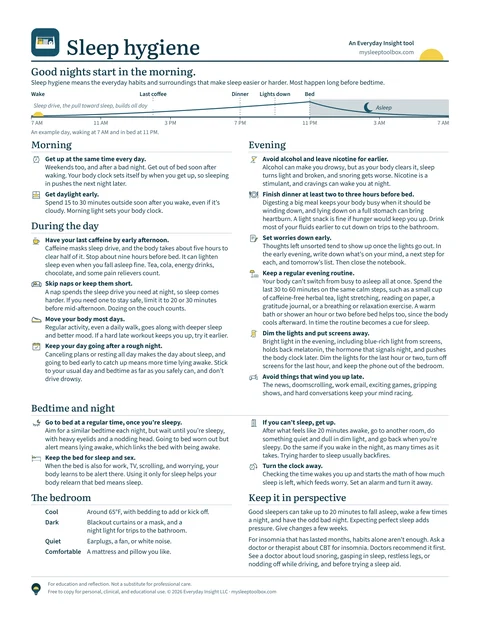
To print. The sleep hygiene handout puts the everyday habits on a single printable sheet, free, in English and Spanish.
What hygiene can and can’t do
On its own, sleep hygiene isn’t a treatment for chronic insomnia. The American Academy of Sleep Medicine recommends against using it by itself for chronic insomnia, and reviews of the research find it does much less than CBT-I.
If you’ve cleaned up every habit and still lie awake, that doesn’t mean you did it wrong. Insomnia that has lasted a while is usually kept going by other things, like too much time in bed, a bed that has become linked with being awake, and worry about sleep. Those are what the sleep window, the stimulus control rules, and “Quiet a busy mind” work on.
Hygiene still matters. Some habits do make sleep lighter, later, or more broken, and they can work against the rest of what you’re doing. An afternoon coffee can make the first weeks of the sleep window harder than they need to be. Bright light late at night can keep nudging your body clock later. Sorting these out keeps them from working against the rest of the plan.
Caffeine
Caffeine works by blocking adenosine, one of the chemicals behind sleep drive. Sleep drive still builds, but its signal gets muffled. When the caffeine wears off, the sleepiness comes back.
It wears off slowly. Caffeine’s half-life, the time it takes the body to clear half of it, is usually between two and a half and five hours in healthy adults, and close to ten in some people. It runs much longer late in pregnancy and in people taking birth control pills, and shorter in people who smoke. A third or more of a mid-afternoon coffee can still be in your system at bedtime.
In one small study of healthy sleepers, a large dose of caffeine, about what’s in four ordinary cups of coffee, taken six hours before bed still cut sleep by more than an hour as measured by a home sleep monitor. By their own reports, people hardly noticed.
Even when it doesn’t keep you from falling asleep, caffeine tends to make sleep shorter and lighter, with less deep sleep.
A 2023 review of 24 studies suggested leaving at least eight to nine hours between a regular cup of coffee and bed, and longer for strong drinks like pre-workout supplements. For someone who goes to bed at 11, that means the last regular cup by about 2 in the afternoon. Older adults may be more sensitive.
Caffeine turns up in coffee, tea, cola and many other sodas, energy drinks, pre-workout powders, chocolate, and some pain relievers and cold medicines. Decaf still has a little. If you cut back, do it over a week or two, since stopping all at once can bring a few days of headaches and tiredness.
Alcohol
A drink in the evening can make it easier to fall asleep, which is why so many people use it that way. The trouble comes later. As the body clears alcohol, sleep in the second half of the night gets lighter and more broken. Alcohol also delays and cuts back REM sleep, and it relaxes the muscles of the throat, which can make snoring and sleep apnea worse.
Several hours between the last drink and bed helps. A nightly drink to fall asleep tends to stop working as well over time, and alcohol combined with sleep medicine is dangerous. If you’ve come to rely on a drink to sleep, that’s worth raising with a doctor.
Nicotine
Nicotine is a stimulant. Smoking or vaping near bedtime can make it harder to fall asleep, and people who smoke tend to sleep more lightly. Cravings can wake people in the night as nicotine levels fall. Quitting can disturb sleep for a few weeks, which is a normal part of withdrawal and usually passes. If you’re quitting, a doctor or pharmacist can help you plan around it.
Exercise
In studies, regular physical activity, even a daily walk, goes along with better sleep, and it’s good for mood and health in its own right.
Many people worry that exercising in the evening will keep them up. A review of studies in healthy adults found that evening exercise generally didn’t harm sleep, and if anything deepened it a little. The exception was hard exercise ending within about an hour of bedtime, which made sleep harder to reach for some people.
So exercise when it fits your day. If evening workouts seem to keep you up, try moving them earlier and see what changes.
Light and screens
Bright light in the morning moves the body clock earlier, and bright light late at night pushes it later. In short, get daylight early, keep lights dim and warm in the last hour or two before bed, and sleep in a dark room. “Your body clock,” in Learn, explains why.
Screens get a lot of blame. In one small lab study, people who read on a tablet for four hours before bed, five nights in a row, took longer to fall asleep, released melatonin later, and were less alert the next morning than when they read printed books. Everyday use is usually less extreme, and turning the brightness down is an easy step. Night-mode color settings have less evidence behind them.
Often the bigger problem is what’s on the screen. Messages, the news, doomscrolling, work email, exciting games, and shows built to keep you watching all hold attention when the mind is meant to be slowing down.
If you use a screen in the evening, choose something easy to stop, put it away for the last hour if you can, and charge the phone outside the bedroom, with a plain alarm clock, turned away, by the bed.
The last hour
Your body can’t switch from busy to asleep all at once. A wind-down routine fills the last 30 to 60 minutes before bed with the same few calm steps, in the same order, on most nights. Do it out of bed, and go to bed when you’re sleepy, not just because the routine is over. In time the routine itself becomes a cue that sleep is coming.
What goes in it is up to you. A small cup of caffeine-free herbal tea, gentle stretching, reading on paper, a breathing or relaxation exercise, or a few lines in a gratitude journal all fit.
Gratitude has some research behind it. In one survey, people who tend to feel grateful reported sleeping better, and went to bed with more pleasant, less negative thoughts. In a review of randomized trials, gratitude exercises improved how people rated their sleep in five of eight studies, though most of the studies had weaknesses. In the app, the gratitude journal and three good things are both in “Quiet a busy mind.” You can also use the gratitude journal and three good things here on the site.
A warm bath or shower an hour or two before bed can help too, and “Your body clock” explains why.
Some things are better kept out of the last hour. Working through problems belongs earlier, in worry time, and so does a hard conversation. Jotting down tomorrow’s list to get it off your mind is fine. Anything bright, exciting, or hard to put down can wait until morning.
In the app, “Wind-down routine,” in “Quiet a busy mind,” lets you build your own and set a reminder for it. On paper, there’s a wind-down routine worksheet.
Food and drink
A large or spicy meal close to bedtime can bring on heartburn and make it harder to get comfortable, and digesting a big meal keeps the body busy when it’s meant to be winding down. Guidelines for reflux suggest finishing meals two to three hours before bedtime, and that’s a sensible gap for most people.
Going to bed hungry can keep you up too, so a light snack is fine if you need one. Drinking a lot in the evening means more trips to the bathroom, so it helps to get most of your fluids earlier in the day.
Naps
Naps spend sleep drive you’d otherwise carry into the night. For someone who sleeps well, a short nap is usually harmless. During CBT-I, most programs ask you to skip them, since the aim is to build drive for the night.
If you need one to stay safe, for example before driving, keep it to 20 or 30 minutes and take it before mid-afternoon. Dozing in front of the TV in the evening counts as a nap too.
The bedroom
A bedroom that’s cool, dark, and quiet suits most people.
- Temperature. A room that’s too warm, especially in humid weather, brings more wakings and less deep sleep. Slightly cool, around 65°F or 18°C, with bedding you can add or kick off, works for most.
- Darkness. Blackout curtains or an eye mask help, especially in summer. If you get up in the night, a dim night light on the way to the bathroom is safer than the overhead light.
- Noise. Earplugs, a fan, or white noise can cover sudden noises.
- Comfort. A mattress and pillow that don’t leave you aching.
- The clock. Turn it away from the bed. “Clock watching” has the reasons.
Partners, children, and pets affect sleep too. Some couples sleep better with separate blankets, and some people find a pet is better off outside the bedroom for a while.
After a bad night
After a rough night, it’s tempting to make the next day about sleep. Canceling plans, resting all day, napping, and going to bed early to catch up all make sense in the moment, and each tends to make the next night harder. Naps spend sleep drive, a day of resting tends to slide into dozing, and an early bedtime adds time lying awake.
Your usual wake time, your usual day, and your usual bedtime, as far as you can safely manage, give the next night its best chance. Sleep drive will be higher, and the next night’s sleep tends to run deeper, as “Why we sleep” explains. If you’re too sleepy to drive or work safely, safety comes first.
Your own patterns
Habits affect people differently. One person can drink coffee at 4 in the afternoon and sleep fine, while another feels a cup at noon.
The diary’s “About yesterday” section asks about things like naps, caffeine, alcohol, exercise, screens, daylight, and stress, and you can choose more in the diary. After a few weeks, “More detail,” in “Week by week,” shows what tends to come before your longer and shorter nights. A pattern like that is a starting point for trying a change. It doesn’t prove what’s causing what.
References
- Edinger, J. D., Arnedt, J. T., Bertisch, S. M., Carney, C. E., Harrington, J. J., Lichstein, K. L., Sateia, M. J., Troxel, W. M., Zhou, E. S., Kazmi, U., Heald, J. L., & Martin, J. L. (2021). Behavioral and psychological treatments for chronic insomnia disorder in adults: An American Academy of Sleep Medicine clinical practice guideline. Journal of Clinical Sleep Medicine, 17(2), 255–262. doi.org/10.5664/jcsm.8986
- Irish, L. A., Kline, C. E., Gunn, H. E., Buysse, D. J., & Hall, M. H. (2015). The role of sleep hygiene in promoting public health: A review of empirical evidence. Sleep Medicine Reviews, 22, 23–36. doi.org/10.1016/j.smrv.2014.10.001
- Drake, C., Roehrs, T., Shambroom, J., & Roth, T. (2013). Caffeine effects on sleep taken 0, 3, or 6 hours before going to bed. Journal of Clinical Sleep Medicine, 9(11), 1195–1200. doi.org/10.5664/jcsm.3170
- Gardiner, C., Weakley, J., Burke, L. M., Roach, G. D., Sargent, C., Maniar, N., Townshend, A., & Halson, S. L. (2023). The effect of caffeine on subsequent sleep: A systematic review and meta-analysis. Sleep Medicine Reviews, 69, 101764. doi.org/10.1016/j.smrv.2023.101764
- Nehlig, A. (2018). Interindividual differences in caffeine metabolism and factors driving caffeine consumption. Pharmacological Reviews, 70(2), 384–411. doi.org/10.1124/pr.117.014407
- Clark, I., & Landolt, H. P. (2017). Coffee, caffeine, and sleep: A systematic review of epidemiological studies and randomized controlled trials. Sleep Medicine Reviews, 31, 70–78. doi.org/10.1016/j.smrv.2016.01.006
- Ebrahim, I. O., Shapiro, C. M., Williams, A. J., & Fenwick, P. B. (2013). Alcohol and sleep I: Effects on normal sleep. Alcoholism: Clinical and Experimental Research, 37(4), 539–549. doi.org/10.1111/acer.12006
- Jaehne, A., Loessl, B., Bárkai, Z., Riemann, D., & Hornyak, M. (2009). Effects of nicotine on sleep during consumption, withdrawal and replacement therapy. Sleep Medicine Reviews, 13(5), 363–377. doi.org/10.1016/j.smrv.2008.12.003
- Stutz, J., Eiholzer, R., & Spengler, C. M. (2019). Effects of evening exercise on sleep in healthy participants: A systematic review and meta-analysis. Sports Medicine, 49(2), 269–287. doi.org/10.1007/s40279-018-1015-0
- Chang, A. M., Aeschbach, D., Duffy, J. F., & Czeisler, C. A. (2015). Evening use of light-emitting eReaders negatively affects sleep, circadian timing, and next-morning alertness. Proceedings of the National Academy of Sciences, 112(4), 1232–1237. doi.org/10.1073/pnas.1418490112
- Okamoto-Mizuno, K., & Mizuno, K. (2012). Effects of thermal environment on sleep and circadian rhythm. Journal of Physiological Anthropology, 31, 14. doi.org/10.1186/1880-6805-31-14
- Katz, P. O., Dunbar, K. B., Schnoll-Sussman, F. H., Greer, K. B., Yadlapati, R., & Spechler, S. J. (2022). ACG clinical guideline for the diagnosis and management of gastroesophageal reflux disease. The American Journal of Gastroenterology, 117(1), 27–56. doi.org/10.14309/ajg.0000000000001538
- Wood, A. M., Joseph, S., Lloyd, J., & Atkins, S. (2009). Gratitude influences sleep through the mechanism of pre-sleep cognitions. Journal of Psychosomatic Research, 66(1), 43–48. doi.org/10.1016/j.jpsychores.2008.09.002
- Boggiss, A. L., Consedine, N. S., Brenton-Peters, J. M., Hofman, P. L., & Serlachius, A. S. (2020). A systematic review of gratitude interventions: Effects on physical health and health behaviors. Journal of Psychosomatic Research, 135, 110165. doi.org/10.1016/j.jpsychores.2020.110165
Helpful links
- American Academy of Sleep Medicine: Healthy sleep habits
- American Academy of Sleep Medicine: Caffeine and sleep
- MedlinePlus: Healthy sleep
Everyday Insight’s tools are for education and personal reflection. They are not therapy or medical care, and they are not for emergencies. In an emergency, call 911. If you are in crisis in the United States, call or text 988.