Three good things
Each night, write down three things that went well today. Next to each one, write why you think it happened. They can be small, like a good cup of coffee, or bigger. Writing the why is what makes this more than a list. It turns your attention to good things and to what brings them about.
The exercise comes from a 2005 study by Martin Seligman and colleagues, who asked people to do it every night for a week. Try it for a week, then see whether you want to keep going.
What you write is saved in this browser, on this device, and nowhere else. Nothing is sent to us.
Tonight’s three
Three things that went well today
For why, think of what you did, what someone else did, or what made it possible.
This browser isn’t letting the page save, which often happens in a private window. You can still write and print, but it will be gone when you close the page.
A few tips
A good cup of coffee or a quiet bus ride is enough.
Often something you did helped, even a little.
The why can be what someone else did, or good timing.
See an example
Three things that went well today
What went well
Finished the report a day early.
Why it happened
I blocked off the morning and turned my phone over.
What went well
Lunch outside with Sam.
Why it happened
We both made time, and the weather held.
What went well
The bus came right as I got to the stop.
Why it happened
Good timing, and I left five minutes early.
Your entries
Nothing saved yet. Each entry you save shows up here, newest first.
Gratitude journal or three good things?
Three good things looks at today: what went well, and why. A gratitude journal is a different practice, about appreciation, where anything you’re grateful for counts, from any time, with no reason needed.
Either one fits the evening, before your wind-down or as part of it. The wind-down routine worksheet has room for it.
On paper
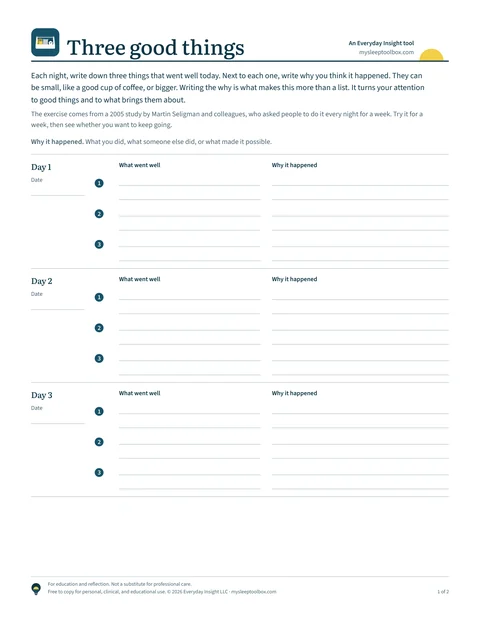
A week of evenings on two pages, with room for what went well and why.
Where it comes from
- Seligman, M. E. P., Steen, T. A., Park, N., & Peterson, C. (2005). Positive psychology progress: Empirical validation of interventions. American Psychologist, 60(5), 410–421. doi.org/10.1037/0003-066X.60.5.410
Everyday Insight’s tools are for education and personal reflection. They are not therapy or medical care, and they are not for emergencies. In an emergency, call 911. If you are in crisis in the United States, call or text 988.