Sleep Toolbox puts the self-help parts of cognitive behavioral therapy for insomnia, often called CBT-I, in one place. There’s a short diary for each morning, a sleep window worked out from your own nights, the rules meant to make the bed a place for sleep again, and plain reading on how sleep works, with the research behind it.
Free. No account. What you enter stays in your browser.
- In your browserThe morning diary and the sleep window calculator. Your nights are saved on this device and print as a report.
- On paperA one-page sleep hygiene handout, one and two week diaries, a sleep window worksheet, and more, in English and Spanish.
- iPhone, iPad, and AndroidOn the App Store for iPhone and iPad and Google Play for Android, with the diary, the sleep window, ways to quiet a busy mind, and a report for your doctor or therapist.
What it is
Cognitive behavioral therapy for insomnia, or CBT-I, is a structured way of working on the habits and worries that keep poor sleep going. It isn’t a list of sleep tips. Most of it comes down to a few plain tools, used steadily for several weeks. The research page explains where they come from and what medical guidelines say about them.
Sleep Toolbox puts those tools in one place, free, in English and Spanish. It describes and organizes. It doesn’t diagnose insomnia or any other sleep problem, and it won’t tell you whether you’ve improved. The numbers are yours to read, or to bring to someone who treats sleep.
The tools
- Sleep diary. A few questions each morning about the night that just ended. It works out time in bed, total sleep, and sleep efficiency the standard way, and keeps your nights in this browser. Week by week sets your last 7 nights beside the 7 before, in plain numbers.
- Sleep window. Matches your time in bed to how much you’re sleeping now, using your own diary, and suggests one change a week. There are two ways to start, the standard window and the gentler sleep compression. You decide every change, and you can undo the last one. It starts with a page called “Before you start,” because it isn’t right for everyone.
- The rules for the bed. Five rules, known as stimulus control, meant to make the bed a place for sleep again.
- Quiet a busy mind. Worry time early in the evening, a wind-down routine, and guided breathing, relaxation, and meditation exercises, each one guided step by step, with narration in a female or male voice, or to read at your own pace. They’re in the app, and the guided exercises, a gratitude journal, and three good things also work here on the site. Calming the body and Racing thoughts at night explain the ideas.
- Learn. Short reads on how sleep works and the thinking behind each tool, in three groups, each with its references. Many have diagrams.
Free to print
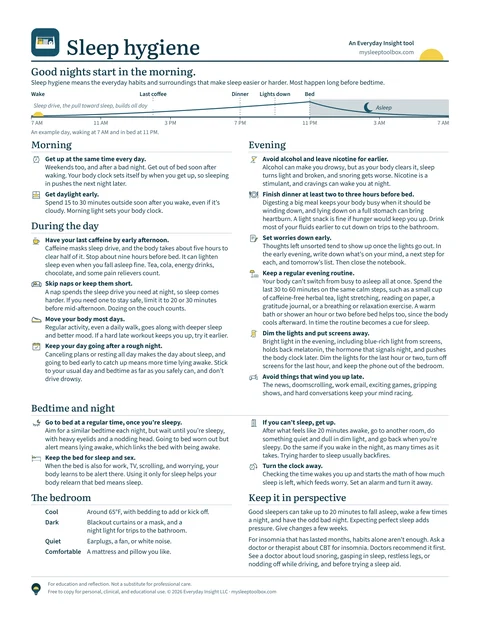
The sleep hygiene handout
The everyday habits that make sleep easier or harder, from morning light to the bedroom at night, on one page. Habits on their own aren’t a treatment for insomnia that has lasted months, and the handout says so. Therapists can hand it to clients or a group. In English and Spanish.
Questions people ask
Does this treat insomnia?
No. Sleep Toolbox is a set of tools and readings based on CBT-I. It isn’t a treatment, a diagnosis, or medical care. If poor sleep has lasted three months or more, or you snore loudly, stop breathing at night, or nod off while driving, talk with a doctor. When to see a doctor.
Why fill in a diary instead of using a watch?
CBT-I runs on your own account of each night, and the sleep window is built from those answers. Watches and rings often disagree with how a night felt. The app can show a watch’s estimate next to your answers if you turn on Apple Health or Health Connect, and it never lets that estimate change the window.
Isn’t less time in bed the opposite of what I need?
It feels that way. Hours of lying awake can teach the body that bed is a place for being awake. The sleep window cuts back time in bed for a while, matched to how much you’re sleeping now, and widens it 15 min at a time in weeks your diary shows you asleep for at least 90% of it. The first weeks are often hard. How the sleep window works.
Where do my answers go?
Nowhere. The diary and the calculator save in your own browser, on this device. Nothing is sent to us, and we have no way to read it. Privacy.
Can I share it with my therapist or doctor?
Yes. The diary prints as a report of the nights you choose, from one night to twelve weeks, with weekly averages and every night laid out, in the same layout the app uses. You can print it or save it as a PDF. For therapists has more on how it fits into care.
The app
Sleep Toolbox for iPhone, iPad, and Android
Everything on this site, plus narrated exercises and reminders you choose.
- Morning diary. Two minutes after you get up. Everything else is built on it.
- Your sleep window. Set times for bed and for getting up, made from your nights.
- Quiet a busy mind. Guided exercises with narration, worry time, a wind-down, and evening writing.
- Learn. Short reads on how sleep and CBT‑I work.